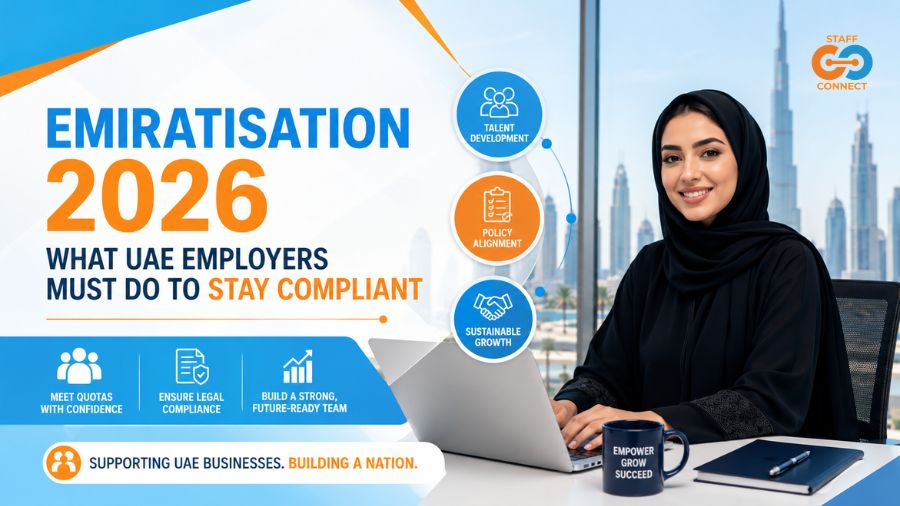

Emiratisation is a strategic policy by the UAE Government to increase the employment of Emirati citizens in meaningful skilled roles across both the public and private sectors, reducing reliance on foreign labor and building a sustainable knowledge-based economy.
Under the new compliance rules for Emiratisation 2026, private-sector companies with 50 or more employees must achieve a 10% skilled force quota and provide a minimum monthly wage of AED 6,000 to all Emirati staff. Any businesses that fail to comply with regulations will face potential financial penalties.
Emiratisation is a national workforce policy of the UAE that aims at reducing the dependency on foreign labor and increasing the participation and representation of Emirati nationals in the private sector. As the expatriate population in 2026 has reached around 88% to 89% of the total population, the government continues to create job opportunities for Emirati citizens to support the economy becoming self-reliant.
To support this objective, the UAE government has introduced Emiratisation 2026 compliance requirements, making it mandatory for businesses to follow them to avoid financial penalties.
Table of Contents
What is Emiratisation?

Emiratisation is referred to as the UAE government workforce policy. It was first introduced in the 1990s with minimal formal enforcement, and later adopted as a well-structured workforce policy in the 2000s.
The Emiratisation policy is designed to increase employment for the Emirati workforce in the public and private sectors by setting Emiratisation targets for private-sector employment. This helps the UAE reduce reliance on foreign labor, while securing job opportunities for skilled citizens.
Emiratisation 2026 Requirements

The UAE government has upgraded its Emiratisation compliance requirements for 2026. Private sector businesses that are registered in the UAE mainland jurisdiction and have 50 or more employees in skilled positions are required to increase Emirati employees in their workforce.
According to the new compliance guidelines, these companies must increase their Emiratisation rate by 2 percentage points every year until they reach the 10% target.
Monitored by the Ministry of Human Resources and Emiratisation (MoHRE) through company payroll records and employment data, any employer that fails to meet these requirements will face financial penalties.
Moreover, the eligible Emirati employee must receive a minimum wage of AED 6,000 per month, and if they leave, the company gets a 2-month replacement window to hire another Emirati national; upon failure, potential fines may apply.
Who Must Comply with Emiratisation Guidelines?

Companies that must comply with Emiratisation requirements include large enterprises and medium-sized companies, depending on the total number of their workforce.
Here is a breakdown:
- Large Companies
Companies that have 50 or more employees must comply with the Emiratisation 2026 compliance framework. They are required to fill 10% of the company’s positions with skilled Emirati employees.
These quotas are applicable for the workforce in MoHRE skill levels 1 to 5, such as managers, professionals, technicians, service, sales, and writing roles. Upon non-compliance or if a business fails to achieve this target, financial penalties may be imposed by the MoHRE.
- Medium Companies
Medium-sized companies across 14 economic sectors, such as real estate, wholesale, retail, and education, are also mandated to comply with Emiratisation 2026 regulations.
Businesses that are operating across any of these sectors with an employee number of 20 to 49 must hire a required number of Emirati nationals depending on applicable sector requirements and government targets. If any employer fails to comply with the regulatory guidelines, it can lead to heavy financial penalties annually.
Common Challenges that Employers May Face

Here are the challenges companies may face alongside their suggested solutions:
| Challenge | Solution |
| Finding Qualified Emirati Candidates | Partner with recruitment agencies like Staff Connect Recruitment Services and build strong talent networks to find suitable candidates. |
| Meeting Emiratisation Targets | Plan hiring early and regularly track workforce requirements to avoid penalties. |
| Retaining Emirati Employees | Provide career growth, training, and a supportive workplace environment. |
| Keeping Up with Regulations | Monitor MoHRE updates and seek professional HR guidance when needed. |
| Managing Documentation | Maintain accurate employee records, contracts, and compliance documents. |
| Finding Suitable Job Matches | Place candidates in roles that match their skills and career goals. |
What Recruitment Agencies Must Know About Emiratisation 2026

Businesses in the UAE depend on recruitment agencies to source national talent for their organizations. This makes it important for them to understand Emiratisation 2026 compliance requirements, helping businesses remain compliant and avoid heavy fines.
Here is what staffing companies in UAE must keep in consideration:
- Understand Emiratisation Requirements: Recruitment agencies, such as IT recruitment companies in UAE, must understand the Emiratisation 2026 rules, quotas, and compliance requirements to help employers hire the right talent.
- Achieve Hiring Targets: A reliable employment agency in Dubai helps employers hire the eligible talent to meet the strict regulatory requirements regarding Emiratisation.
- Compliance Planning: A professional staffing company in Dubai or the UAE must provide expert advice to their clients on workforce planning, hiring timelines, and effective strategies to achieve Emiratisation targets to prevent heavy penalties.
- Promote Quality Hiring: Recruiting companies should focus on hiring high-quality talent, helping companies sustain employees for a long time. This helps companies hire Emirati nationals who are a strong fit for the role rather than those who leave after some time, which puts a burden on the employer to fill the position in 2 months.
Conclusion
Businesses must understand the Emiratisation 2026 requirements to stay compliant and avoid potential penalties. By including a strong hiring strategy, partnering with a reliable hiring agency, and workforce planning, companies can achieve the required goals and find qualified Emirati professionals.
If you are a business looking to hire eligible Emirati nationals to maintain compliance with the UAE workforce policy, you can connect with Staff Connect. We are a reliable staffing company in Dubai that helps companies hire skilled professionals in Dubai. Our team provides complete onboarding support. Therefore, contact us today to get professional hiring support in Dubai.
